CS Beef Packers Recalls 22,912 Pounds of Ground Beef Over E. coli O145
A Class I recall of ground beef sent to foodservice distributors in three states puts children under 5, older adults and people with weakened immune systems at highest risk of severe illness.
By Dustin Reed Terry, Founder & Editor · Published
Federal food safety officials announced on Feb. 11, 2026, that CS Beef Packers, LLC, a Kuna, Idaho, establishment, is recalling approximately 22,912 pounds of raw ground beef that may be contaminated with E. coli O145, a Shiga toxin-producing strain that the USDA Food Safety and Inspection Service treats as a serious hazard. The recall, numbered 003-2026 and classified Class I, covers ground beef produced on Jan. 14, 2026, and shipped to distributors in California, Idaho and Oregon for further distribution to foodservice locations, according to the FSIS notice.
The agency said there have been no confirmed reports of illness tied to the products. It also said it is concerned that some of the beef may still be in foodservice freezers, and it urged foodservice operators not to serve it.
What was recalled and how to identify it
The recall involves three raw ground beef products, all packed in 10-pound chubs and all bearing the establishment number EST. 630 inside the USDA mark of inspection, both on the outside of the case and printed directly onto the clear packaging of each chub:
- Cardboard cases containing eight 10-lb. chubs of BEEF, COARSE GROUND, 73 L, case code 18601.
- Cardboard cases containing four 10-lb. chubs of FIRE RIVER FARMS CLASSIC BEEF FINE GROUND 73L, case code 19583.
- Cardboard cases containing four 10-lb. chubs of FIRE RIVER FARMS CLASSIC BEEF FINE GROUND 81L, case code 19563.
All three carry a Use/Freeze By date of 02/04/26 and time stamps between 07:03 and 08:32, printed on two stickers placed on the outside of the case and also printed directly on the chub packaging. The chub format and the case codes make clear this is a commercial, bulk-pack item rather than a retail package: it was sold into the foodservice supply chain, not to shoppers at a grocery meat case.
FSIS said the products were shipped to distributors in California, Idaho and Oregon. When available, retail distribution lists are posted on the agency's recalls website.
Why this hazard matters most for young children and older adults
E. coli O145 is a serovar of Shiga toxin-producing E. coli, the same broad family as the more familiar O157:H7, according to FSIS. People can become ill two to eight days after exposure, with an average of three to four days. Most people infected develop diarrhea, often bloody, and vomiting. Some illnesses last longer and are more severe. Diagnosis is usually made through a stool sample, and the usual treatment is vigorous rehydration and other supportive care; antibiotic treatment is generally not recommended.
Most people recover within a week. The reason a Class I recall demands attention is the rare but serious complication: hemolytic uremic syndrome, a type of kidney failure. FSIS describes HUS as uncommon with STEC O145 infection, but notes it can occur in people of any age and is most common in children under 5 years old, older adults and people with weakened immune systems. It is marked by easy bruising, pallor and decreased urine output, and anyone with those symptoms should seek emergency medical care immediately.
That profile is what makes a foodservice recall a family-protection story. Foodservice is a broad category that can run from restaurant kitchens to workplace and school cafeterias to the dining operations of senior living communities and hospitals. In those settings, the person eating never sees a cardboard case, a case code or a Use/Freeze By sticker. The people most exposed to severe STEC illness are, in many cases, the people least positioned to inspect the label themselves.
How the problem was found, and what it says about the system
The contamination was not detected at the Kuna plant. According to the notice, the problem was discovered during FSIS testing at a downstream customer, and the sampling results showed the presence of E. coli O145. That is a meaningful detail: the agency's verification testing caught the pathogen after the product had already moved into commerce, which is why the recall reaches back to distributors in three states rather than stopping at a single loading dock.
It also underscores how thin the margin can be. The product was produced Jan. 14, 2026, and carried a Use/Freeze By date of 02/04/26, a week before the recall was announced. Any portion still in the supply chain on Feb. 11 would therefore most likely have been frozen, which is precisely why the agency flagged foodservice freezers as a concern. Freezing does not kill Shiga toxin-producing E. coli; it preserves the organism until the product is thawed and, if undercooked, served.
FSIS said it routinely conducts recall effectiveness checks to verify that the recalling firm notified its customers and that steps were taken to ensure the product is no longer available. The agency's recall record for this event lists the case as closed, which reflects the agency's recall process rather than a guarantee that every pound has been accounted for.
What consumers and families should do now
Because these products were not sold at retail, households cannot check their own freezers for the case codes. The practical protections are different, and they are worth rehearsing before the next meal out.
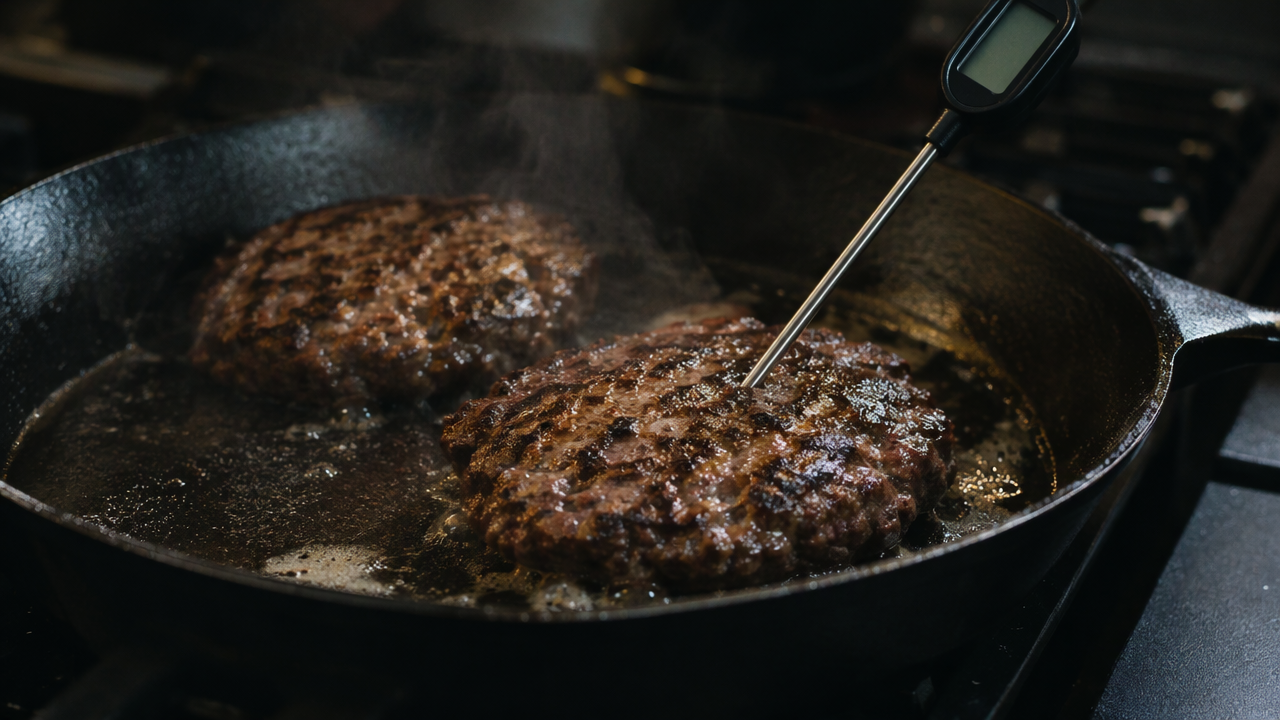
At home, the single most reliable safeguard is temperature. FSIS advises consumers to cook ground beef to an internal temperature of 160 degrees Fahrenheit and states that the only way to confirm ground beef is cooked high enough to kill harmful bacteria is to use a food thermometer that measures internal temperature. Color is not a safety test; a browned patty can still be undercooked in the center. Ground beef, unlike whole muscle cuts, has surface bacteria mixed throughout during grinding, so the interior must reach temperature too.
When eating away from home, families with young children, older relatives or immunocompromised members can ask that ground beef be cooked through to 160 F rather than served pink in the middle, and can ask staff at a cafeteria or institutional dining room whether the kitchen has received any recall notice. Anyone who believes they encountered a problem product can report it through FSIS's online Electronic Consumer Complaint Monitoring System, which is available 24 hours a day.
Anyone concerned about an illness after eating ground beef should contact a healthcare provider, and should mention the possibility of STEC exposure so that stool testing can be considered.
The watchdog takeaway
A Class I classification means FSIS has determined there is a reasonable probability that use of the product will cause serious adverse health consequences or death. It is the agency's most serious recall tier, and it was applied here before a single illness was confirmed: no confirmed reports of illness had been linked to these products when the notice was issued. That is how the system is supposed to work, catching risk on the front end through sampling rather than waiting for a cluster of sick children.
The lesson for households is that some of the most consequential food safety decisions are made outside the home, in kitchens that answer to distributors rather than to shoppers. Consumers can close part of that gap by knowing the establishment number system, by taking 160 F seriously at their own stove, and by asking questions at the counter, the cafeteria line and the dining room.
- Know the recall: CS Beef Packers, LLC, EST. 630, three bulk ground beef items with case codes 18601, 19583 and 19563, Use/Freeze By 02/04/26, time stamps 07:03 to 08:32.
- Understand the distribution: shipped to distributors in California, Idaho and Oregon for foodservice use, not retail sale.
- Cook ground beef to 160 F, measured with a food thermometer in the thickest part.
- Never rely on color, texture or juices running clear to judge doneness.
- Wash hands, utensils and cutting boards after contact with raw ground beef, and keep raw meat away from ready-to-eat foods.
- Ask restaurants, cafeterias and institutional kitchens to cook ground beef through, and to confirm they have checked recall notices.
- Report suspected problems to FSIS at foodcomplaint.fsis.usda.gov, and call the USDA Meat and Poultry Hotline at 1-888-674-6854 with food safety questions.
- Seek emergency care for easy bruising, pallor or decreased urine output after diarrheal illness, especially in a child under 5 or an older adult.
Consumers with questions about this recall can contact Roger Cooper, Operations Manager of CS Beef Packers, LLC, at 208-810-7510 ext. 7531. The full scope of the recall, including case codes and product labels, is available on the MeatRecalls.com full recall details and product list, and the primary source remains the official USDA FSIS notice.